
Adaptive Capacity: What Happens When Life Demands More From Your Body?
Longevity has become a crowded conversation. Testosterone optimization, peptides, supplements, biological age testing, continuous glucose monitors, hormone panels, and emerging therapeutics receive enormous attention. Some of these tools have legitimate clinical applications. Some are promising areas of research. Others have considerably more marketing behind them than long term human outcomes data.
What can get lost in that conversation is something much less exotic: the ability of the human body to tolerate physical demand, respond appropriately, recover, and remain capable over time.
At Longevity Gyms, we think about this broadly as adaptive capacity.
Adaptive capacity is not a single laboratory value, and there is no universally accepted “adaptive capacity score” that tells someone how well they are aging. It is better understood as a framework for thinking about physiological reserve and resilience. What happens when demand increases? How much capacity is available? How effectively does the body respond? How well does it recover? And what happens to those abilities over the course of years?
Those questions may be less exciting than the latest peptide discussion, but they are fundamental to the practical meaning of healthspan.
Longevity Is Not Just the Absence of Disease
Most people understandably want to avoid cardiovascular disease, cancer, diabetes, dementia, osteoporosis, and other conditions associated with aging. Prevention, early detection, and appropriate medical management of disease remain essential components of longevity.
But the absence of a diagnosis does not necessarily mean that physical capacity is being preserved.
A person can have acceptable laboratory values and still have poor cardiorespiratory fitness. Someone can maintain a normal body weight while carrying relatively little skeletal muscle. Another person may have no major medical diagnosis but progressively lose strength, mobility, balance, and exercise tolerance.
These changes matter because longevity is not simply about remaining alive. Healthspan includes maintaining enough physical and physiological capacity to continue functioning well as the demands of life change.
This is where the concept of reserve becomes useful.
A body with greater reserve has more capacity available when demand increases. Exercise is one way we can observe this directly because it requires the cardiovascular, respiratory, metabolic, muscular, and nervous systems to respond simultaneously.
What Do We Mean by Adaptive Capacity?
In aging research, the related concept of physiological resilience describes the ability of an organism to respond to and recover from a stressor. Researchers are increasingly interested in whether the dynamics of that response may provide information that static measurements cannot.
The concept is intuitive.
At rest, two people may appear relatively similar. When physiological demand increases, important differences can emerge.
Exercise provides a controlled example. Heart rate rises. Cardiac output increases. Ventilation increases. Oxygen consumption rises. Skeletal muscle requires more energy. Metabolism responds to increasing workload. After exercise ends, these systems begin moving back toward baseline.
The ability to generate an appropriate response depends on available physiological capacity.
This does not mean an exercise test measures every dimension of biological resilience. It does not. Illness, surgery, sleep deprivation, psychological stress, heat, nutritional stress, and other challenges involve different physiological systems and responses.
What exercise does provide is an opportunity to objectively examine several components of physical capacity under increasing demand.
That is useful information.
One of the Biggest Threats to Longevity Is Loss of Reserve
Age itself is not a disease, but aging is accompanied by physiological changes that can reduce reserve across multiple systems.
Cardiorespiratory fitness can decline. Muscle mass and strength can decline. Bone density can decrease. Recovery may become slower. Metabolic health can deteriorate. Balance and mobility can change.
These changes do not occur at the same rate in every person, nor are they entirely determined by chronological age.
This is important because the consequences of declining reserve may not become obvious during normal daily life until the margin between available capacity and required capacity becomes smaller.
Walking across a parking lot may require little of someone's maximal aerobic capacity at age 40. Years later, the same task may represent a substantially larger percentage of available capacity if cardiorespiratory fitness has declined.
Standing from a chair requires a certain amount of lower body strength. Carrying luggage requires strength. Climbing stairs requires both muscular and cardiovascular capacity. Recovering balance after a misstep requires strength, coordination, and neuromuscular control.
The activities do not necessarily become harder.
The available reserve can become smaller.
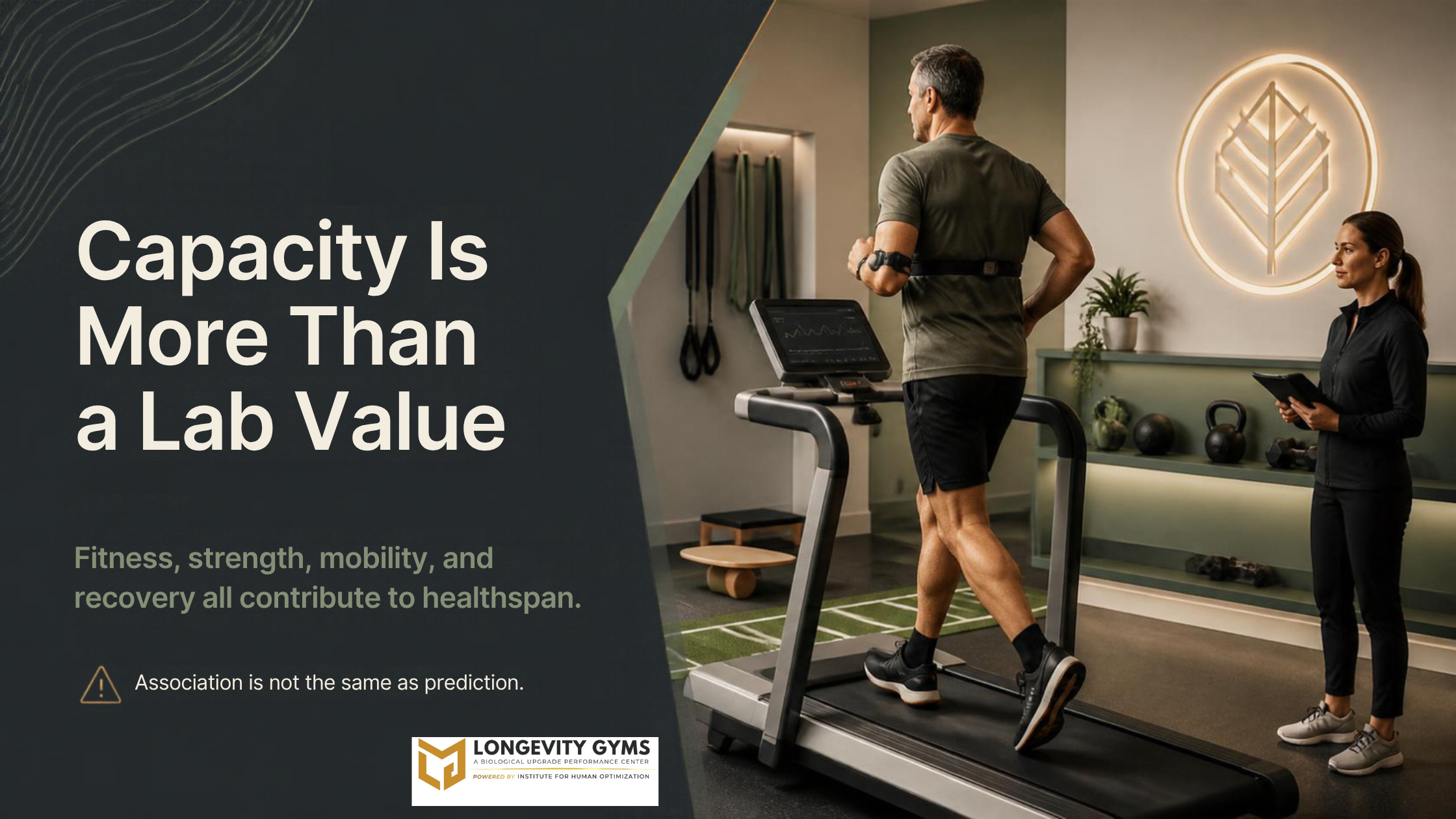
Cardiorespiratory Fitness Is Difficult to Ignore
If we are going to have a serious conversation about longevity, cardiorespiratory fitness deserves a prominent place in it.
A 2024 overview of meta analyses evaluated data representing more than 20.9 million observations from 199 unique cohort studies. Higher cardiorespiratory fitness was consistently associated with lower risks of mortality and multiple chronic conditions.
In analyses of all cause mortality, every 1 MET higher level of cardiorespiratory fitness was associated with an approximately 11 to 17 percent lower risk of death.
These are observational associations and should not be interpreted as a guarantee that increasing fitness by a specific amount will extend an individual's lifespan by a predictable number of years.
They do, however, demonstrate the remarkable consistency with which physical fitness is associated with health outcomes.
VO₂ max gives us one way to objectively measure this component of capacity.
The number is useful not because it predicts an expiration date, but because it tells us something meaningful about how much aerobic capacity the body currently has.
Muscle and Strength Are Part of the Same Conversation
Cardiorespiratory fitness is only one component of reserve.
Skeletal muscle and strength deserve similar attention.
Muscle supports movement, balance, glucose metabolism, mobility, and physical function. Strength determines whether that muscle can generate enough force to meet the demands placed on it.
Large observational studies have repeatedly demonstrated associations between muscular strength and health outcomes. A systematic review and meta analysis involving approximately 1.9 million adults found higher muscular strength was associated with lower all cause mortality.
Another systematic review examining grip strength and mortality included more than three million participants.
As with cardiorespiratory fitness, these studies demonstrate association rather than proving that grip strength itself prevents death. Grip strength is useful partly because it provides an accessible indicator of broader muscle function and physical status.
The practical point is simpler: losing strength and muscle with age should not be treated as irrelevant simply because it happens gradually.
Frailty Is What Loss of Reserve Can Eventually Look Like
At the other end of the adaptive capacity conversation is frailty.
Frailty is a clinical syndrome involving increased vulnerability to stressors. Someone with diminished physiological reserve may have greater difficulty recovering from an illness, injury, hospitalization, or other challenge.
This is not the same thing as simply being old.
People of the same chronological age can have dramatically different levels of physical capacity and vulnerability.
Research on healthy aging increasingly recognizes this heterogeneity. Recent scientific work on resilience based longevity medicine has specifically proposed adaptive capacity, recovery dynamics, physiological flexibility, and functional performance as important components for understanding differences in aging trajectories.
This shifts the question away from chronological age alone.
Instead of asking only how old someone is, we can also ask what level of capacity remains.
The Hallmarks of Aging Matter. So Does What You Can Actually Do.
Modern longevity science has appropriately focused considerable attention on the biological mechanisms of aging.
The Hallmarks of Aging framework describes interconnected processes including genomic instability, telomere attrition, epigenetic alterations, loss of proteostasis, altered nutrient sensing, mitochondrial dysfunction, cellular senescence, stem cell exhaustion, and altered intercellular communication. Subsequent work has expanded this framework.
These mechanisms are scientifically important and may ultimately produce new therapeutic targets.
There is also substantial research examining how exercise interacts with many biological processes associated with aging.
Regular physical activity influences mitochondrial function, metabolic regulation, inflammatory signaling, cardiovascular function, skeletal muscle, and numerous other systems. Research continues to investigate how exercise may influence multiple hallmarks of aging.
That makes exercise unusually interesting.
It is not a single molecular intervention directed at one pathway. It creates a physiological demand that requires multiple systems to adapt.
The outcome we ultimately care about is not simply whether a molecular pathway changed on a laboratory report. We also care whether the person remains physically capable.
Where Testosterone Fits
Testosterone deserves a more nuanced discussion than either extreme commonly receives online.
Testosterone is physiologically important. In appropriately diagnosed individuals, testosterone therapy has legitimate medical indications and can be clinically valuable.
It is not, however, a substitute for physical capacity.
A favorable testosterone level does not tell us someone's VO₂ max. It does not tell us whether they have adequate strength, how much visceral fat they carry, how efficiently they tolerate exercise, or whether they can climb several flights of stairs comfortably.
Hormones can influence physiology, body composition, recovery, and performance. They remain one component of a much larger system.
Longevity becomes too narrow when optimization is reduced to achieving a particular hormone number while cardiorespiratory fitness, muscle, strength, mobility, sleep, nutrition, and physical activity receive less attention.
Peptides Are Not a Substitute for Capacity Either
Peptides have generated enormous interest in performance and longevity circles.
The category itself is broad. Some peptide based medications have established medical indications and substantial clinical evidence. Other compounds marketed in wellness and performance settings have limited human data, are investigational, or lack regulatory approval for the purposes for which they are promoted.
It is therefore inappropriate to discuss “peptides” as though they are one intervention with one evidence base.
The more important point for longevity is that no peptide eliminates the need to maintain physical capacity.
A compound may eventually prove useful for a particular clinical indication. That is a different question from whether someone has sufficient cardiorespiratory fitness, muscle, strength, balance, and mobility.
The most sophisticated longevity strategy can still have a very basic weakness if the person becomes progressively less physically capable.
Exercise Is a Stressor, and That Is Part of Its Value
The word stress is usually treated negatively, but physiological stress is not inherently harmful.
Exercise temporarily disrupts homeostasis.
Heart rate increases. Energy demand rises. Muscle experiences mechanical tension. Metabolic substrates are used. Cellular signaling changes.
Recovery then provides an opportunity for adaptation.
With an appropriate dose of training and sufficient recovery, repeated exposure can result in improved fitness, strength, muscle function, and other physiological adaptations.
This is one reason exercise has such a unique place in longevity.
The objective is not to eliminate stress from the body. The objective is to develop enough capacity to tolerate appropriate stress and recover from it.
Too little challenge provides insufficient stimulus. Excessive demand without adequate recovery can become counterproductive.
Adaptation occurs between those extremes.
Recovery Matters Because Adaptation Requires It
Adaptive capacity should not become an excuse to train harder every day.
Training provides the stimulus. Recovery is part of the process through which the body responds to that stimulus.
Sleep, nutrition, training volume, training intensity, illness, psychological stress, and other factors influence recovery.
This is why performance and recovery should not be treated as opposing concepts.
An athlete understands this intuitively. A hard training session followed by inadequate recovery does not automatically produce better performance.
The same principle becomes increasingly relevant when training for healthspan.
The objective is to create enough stimulus to maintain or improve capacity while providing enough recovery to support continued adaptation.
Capacity Can Be Measured
One advantage of focusing on physical capacity is that many of its components can be objectively assessed.
VO₂ max can provide information about cardiorespiratory fitness.
Body composition can provide information about skeletal muscle and body fat.
Strength testing can provide information about force production.
Lactate testing can help athletes understand metabolic responses to increasing workloads.
Mobility and functional assessments can provide additional information about how effectively someone moves.
No single measurement defines adaptive capacity.
Together, appropriate measurements can help establish a more useful picture of where someone currently stands.
This matters because subjective impressions can be misleading. Someone may feel “pretty fit” because they exercise several times per week while having never measured aerobic capacity. Another person may appear lean while carrying relatively little skeletal muscle.
Testing does not replace judgment.
It gives judgment better information.
This Is Why Longevity Gyms Exists
Longevity medicine has become increasingly sophisticated, and that is a positive development. We have better diagnostics, more effective treatments, better weight management tools, emerging therapeutics, and unprecedented access to health information.
But longevity should not become so technologically sophisticated that we forget to measure whether the human being is physically capable.
Longevity Gyms was built to occupy that space.
We are interested in VO₂ max because aerobic capacity matters.
We measure body composition because muscle and visceral fat matter.
We use performance testing because exercise physiology cannot always be understood from a generic formula.
We care about recovery because adaptation requires both stimulus and recovery.
And we use technologies when they have a rational place within that larger objective.
The technology is not the philosophy.
Building and preserving capacity is the philosophy.
Medical Disclaimer
This article is provided for educational and informational purposes only and is not intended to provide medical advice, diagnosis, or treatment. The concepts of adaptive capacity, physiological resilience, and physical reserve discussed here describe broad areas of physiology and aging research and should not be interpreted as a diagnostic test or medical diagnosis. Hormone therapy, peptide based medications, prescription therapies, and other medical interventions require individualized evaluation and appropriate medical oversight. Consult an appropriately qualified healthcare professional regarding personal medical concerns, symptoms, diagnoses, medications, or treatment decisions. Longevity Gyms testing and services are not substitutes for individualized medical care.
Selected References
Lang JJ, Prince SA, Merucci K, et al. Cardiorespiratory Fitness Is a Strong and Consistent Predictor of Morbidity and Mortality Among Adults: An Overview of Meta Analyses Representing Over 20.9 Million Observations From 199 Unique Cohort Studies. British Journal of Sports Medicine. 2024;58:556 to 566.
García Hermoso A, Cavero Redondo I, Ramírez Vélez R, et al. Muscular Strength as a Predictor of All Cause Mortality in an Apparently Healthy Population: A Systematic Review and Meta Analysis of Data From Approximately 2 Million Men and Women. Archives of Physical Medicine and Rehabilitation. 2018;99(10):2100 to 2113.
Núñez Cortés R, Del Pozo Cruz B, Gallardo Gómez D, et al. Handgrip Strength Measurement Protocols for All Cause and Cause Specific Mortality Outcomes in More Than 3 Million Participants: A Systematic Review and Meta Regression Analysis. Clinical Nutrition. 2022;41(11):2473 to 2489.
Coelho Júnior HJ, Calvani R, Azzolino D, et al. Low Muscle Mass in Older Adults and Mortality: A Systematic Review and Meta Analysis. Experimental Gerontology. 2021.
López Otín C, Blasco MA, Partridge L, Serrano M, Kroemer G. The Hallmarks of Aging. Cell. 2013;153(6):1194 to 1217.
Garatachea N, Pareja Galeano H, Sanchis Gomar F, et al. Exercise Attenuates the Major Hallmarks of Aging. Rejuvenation Research. 2015;18(1):57 to 89.
Boccardi V, et al. Resilience Based Longevity Medicine: A Multiscale and Dynamic Integrative Framework. Ageing Research Reviews. 2026.
