
Beyond the Scale: Why Muscle Mass Matters More Than Ever
Body weight has historically dominated the conversation around weight management. We track pounds lost, calculate BMI, establish goal weights, and often use the number on the scale as the primary measure of progress. Those measurements have value, but they provide an incomplete picture of what is actually changing inside the body.
This has become particularly relevant with the rise of GLP 1 based therapies. These medications have transformed medical weight management and can be highly effective tools for appropriately selected patients under medical supervision. As meaningful weight loss becomes achievable for more people, however, there is an opportunity to become more sophisticated about how we measure success.
Losing 20, 30, or 50 pounds is meaningful. But if we want to understand the quality of that change, we also need to ask what happened to body fat, visceral fat, and skeletal muscle along the way.
At Longevity Gyms, this is one reason we place significant emphasis on measuring body composition and, in particular, monitoring skeletal muscle mass.
Weight Tells You How Much. Body Composition Tells You More.
A traditional scale measures total body weight. That number represents skeletal muscle, body fat, bone, organs, water, and other tissues combined into a single measurement.
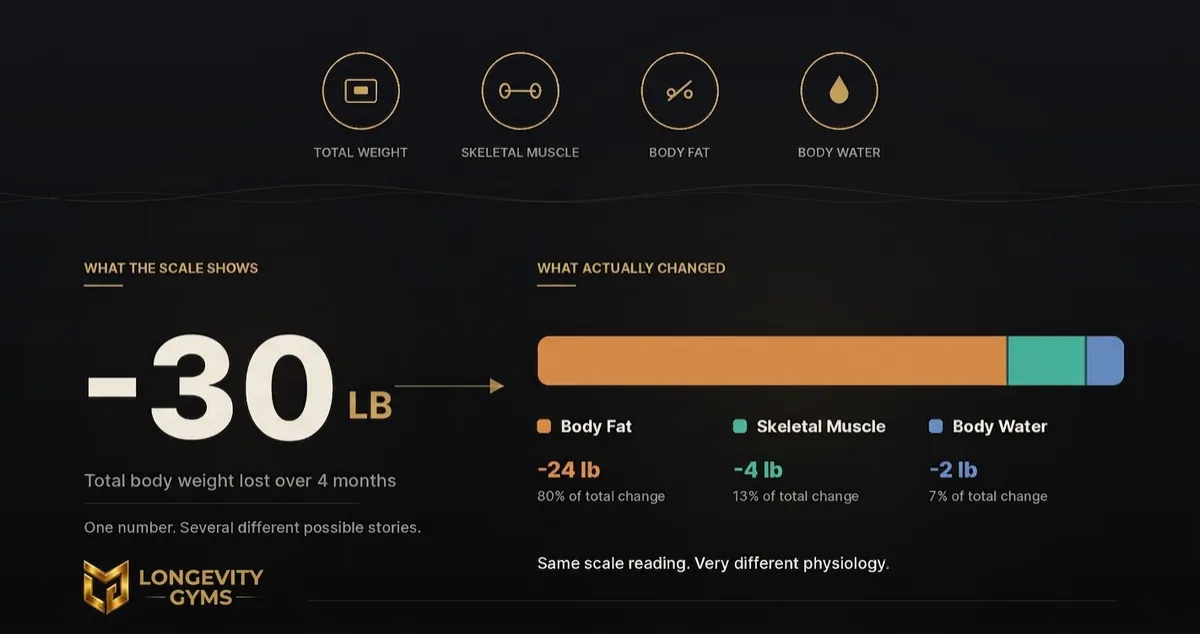
If someone weighs 220 pounds at the beginning of a weight loss program and 190 pounds several months later, the scale accurately tells us that 30 pounds of body mass has been lost. What it cannot tell us is what contributed to that change.
This distinction matters because weight loss does not occur exclusively through reductions in body fat. Changes in lean tissue can occur during substantial weight loss as well. This is not unique to GLP 1 therapy. It can occur with caloric restriction, lifestyle interventions, bariatric procedures, pharmacologic weight management, and combinations of these approaches.
The goal is not to make people concerned about every fluctuation in lean mass. The goal is to collect enough information to understand what is happening rather than assuming that every pound lost represents the same physiological change.
BMI Is Useful, but It Was Never Designed to Measure Muscle
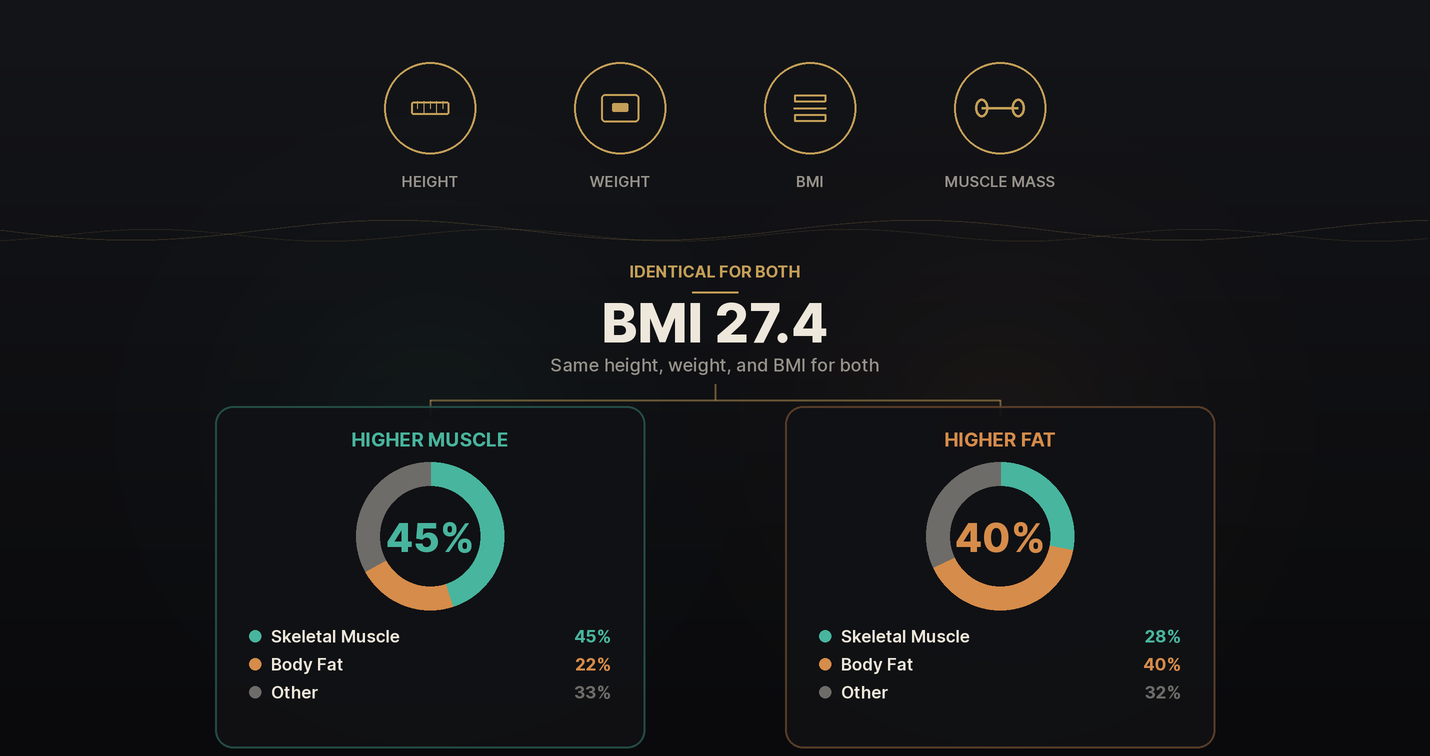
BMI remains a useful screening tool. It is inexpensive, standardized, widely studied, and provides useful information when evaluating weight relative to height. Its limitation is that it does not directly measure body composition.
Two people can have the same height, weight, and BMI while having substantially different amounts of skeletal muscle and body fat. One may carry more muscle and relatively less adipose tissue, while another may carry less muscle and more body fat. Their BMI may be identical because BMI cannot distinguish between those tissues.
The same limitation applies when someone loses weight. A reduction in BMI confirms that body weight relative to height has decreased, but it does not tell us how skeletal muscle, fat mass, or fat distribution changed.
This does not make BMI obsolete or unhelpful. It simply means that BMI and body composition answer different questions. If the question is what someone's weight is relative to height, BMI is useful. If the question is how much muscle and fat someone carries, a different measurement is required.
Why Skeletal Muscle Deserves More Attention
Skeletal muscle is often discussed in the context of strength, athletic performance, or appearance, but its physiological importance extends considerably further. Muscle contributes to movement, glucose metabolism, balance, mobility, physical function, and our ability to tolerate increasing physical demands.
Its importance also becomes increasingly apparent with age. Sarcopenia refers to the progressive loss of muscle mass, strength, and physical function that can occur with aging. Current clinical frameworks increasingly emphasize that muscle health cannot be evaluated by mass alone. Strength and physical performance are also important components of the picture.
There is also growing recognition of sarcopenic obesity, where excess adiposity and impaired muscle health coexist. This is particularly relevant to a conversation that has historically focused heavily on total body weight. A person can carry excess body fat while simultaneously having relatively low muscle mass or impaired muscle function.
Looking only at the scale can make that distinction difficult to see.
GLP 1 Therapies Have Changed the Weight Management Landscape
GLP 1 based medications have become important tools in modern obesity medicine. For appropriate patients, they can produce substantial weight reduction and improvements in important metabolic outcomes.
That is a positive development.
Their effectiveness also gives us a compelling reason to improve how progress is monitored. When relatively large changes in body weight occur, it becomes increasingly useful to understand what is happening to the different components of that weight.
Clinical trials evaluating GLP 1 based therapies have generally demonstrated that the majority of weight reduction comes from fat mass, while some reduction in lean mass can also occur. This pattern is not exclusive to medication assisted weight loss. Lean tissue changes are commonly observed during significant weight reduction through multiple approaches.
The appropriate response is not to characterize GLP 1 therapy as harmful to muscle. That oversimplifies the evidence and ignores the significant benefits these medications can provide for appropriate patients. Instead, it creates a practical question for anyone undergoing substantial weight loss: How is your body composition changing while your weight decreases?
That is something we can measure.
Why Muscle Measurement Matters During Weight Loss
Consider two people who each lose 30 pounds. If the only measurement being followed is body weight, their outcomes appear identical. A body composition assessment may show that the distribution of those changes is quite different.
This information can provide additional context when evaluating progress. Rather than simply knowing that body weight decreased, we can look at changes in skeletal muscle mass, total body fat, body fat percentage, and visceral fat estimates.
For someone using medically supervised GLP 1 therapy, this can be particularly useful because substantial weight reduction may occur over a relatively concentrated period of time. Establishing body composition early in the process provides a baseline against which future measurements can be compared.
Instead of waiting until a large amount of weight has already been lost and wondering what happened to muscle along the way, body composition can be followed as part of the process.
Muscle Mass and Muscle Function Are Not the Same Thing
There is an important scientific distinction between measuring muscle mass and measuring muscle function. A body composition test can estimate how much skeletal muscle someone carries, but it does not independently tell us how strong that person is or how well that muscle performs.
Strength, mobility, balance, and physical performance provide additional information. Someone may have an adequate quantity of muscle but poor strength or function, while another person may perform well despite having a different amount of measured muscle mass.
This is why Longevity Gyms does not view any single measurement as a complete assessment of physical capacity. Body composition is valuable because it answers specific questions about the distribution of muscle and fat. Other assessments answer different questions about fitness and performance.
The objective is not to find one perfect metric. It is to use the right measurement for the question being asked.
Visceral Fat Matters Too
Looking beyond the scale also allows us to consider where body fat is distributed. Visceral fat is stored within the abdominal cavity around internal organs and has a stronger relationship with cardiometabolic risk than body weight alone can demonstrate.
This means that two people with similar weights or even similar total body fat percentages may have different patterns of fat distribution. Monitoring changes in visceral fat can therefore add another layer of information when evaluating changes in body composition.
For someone losing weight, seeing a reduction in visceral fat while monitoring skeletal muscle provides a much more informative picture than simply recording pounds lost.

The Goal Is Not to Stop Caring About Weight
There is no need to choose between body weight and body composition. Weight is useful. BMI is useful. Waist circumference can be useful. Body composition is useful. Each measurement provides different information.
The problem arises when one number is expected to answer every question.
If someone has a clinically meaningful amount of excess body weight, losing weight can produce substantial health benefits. Body composition analysis does not diminish that accomplishment. It provides additional information about how the body is changing during the process.
This is especially relevant in an era when highly effective weight management tools can produce significant changes in body weight. The better our interventions become, the more opportunity we have to improve the way we measure their results.
Why Longevity Gyms Uses InBody
At Longevity Gyms, we use InBody body composition analysis to look beyond total body weight and establish a more detailed baseline.
The assessment provides information related to skeletal muscle mass, body fat, body fat percentage, segmental lean analysis, and visceral fat. This allows us to evaluate changes that cannot be seen on a conventional scale.
For someone beginning a weight loss program, currently undergoing medically supervised GLP 1 therapy, starting a strength program, or simply interested in understanding their body composition, baseline testing provides a reference point.
Repeat testing then allows those measurements to be compared over time.
This is particularly important to us when significant weight loss is occurring. We want to see the reduction in weight and body fat, but we also want skeletal muscle to remain part of the conversation.
Measure. Match. Re Measure.
The Longevity Gyms approach is built around establishing objective baselines and using those measurements with purpose.
For body composition, that means measuring skeletal muscle, body fat, and visceral fat rather than relying exclusively on total body weight. Those measurements can then be considered alongside the individual's goals and measured again over time.
This is especially relevant as GLP 1 therapies continue to change what is possible in weight management. These medications can be excellent tools. Our position is not that successful weight loss should be viewed with suspicion. It is that significant weight loss gives us an opportunity to measure more than pounds.
If the scale is moving, we want to understand what is moving with it.
Start With Your Body Composition
If you are using medically supervised GLP 1 therapy, beginning a weight loss program, starting strength training, or simply want a more complete understanding of your body composition, InBody testing can establish a baseline for skeletal muscle, body fat, and visceral fat.
EXPLORE INBODY BODY COMPOSITION TESTING
When you are ready to begin your Longevity Gyms experience: START YOUR UPGRADE
Explore testing, performance, recovery, and optimization at Longevity Gyms:
Medical Disclaimer
This article is provided for educational and informational purposes only and is not intended to provide medical advice, diagnosis, or treatment. Information presented is general in nature and may not apply to every individual. Prescription weight management medications, including GLP 1 based therapies, require individualized medical evaluation and appropriate clinical oversight. Consult a qualified healthcare professional regarding personal medical concerns, symptoms, medications, diagnoses, or treatment decisions. Longevity Gyms services and body composition assessments are not substitutes for individualized medical care.
References
Heymsfield SB, Wadden TA. Mechanisms, Pathophysiology, and Management of Obesity. New England Journal of Medicine. 2017;376:254 to 266.
Cruz Jentoft AJ, Bahat G, Bauer J, et al. Sarcopenia: Revised European Consensus on Definition and Diagnosis. Age and Ageing. 2019;48(1):16 to 31.
Donini LM, Busetto L, Bischoff SC, et al. Definition and Diagnostic Criteria for Sarcopenic Obesity: ESPEN and EASO Consensus Statement. Clinical Nutrition. 2022;41(4):990 to 1000.
Wilding JPH, Batterham RL, Calanna S, et al. Once Weekly Semaglutide in Adults with Overweight or Obesity. New England Journal of Medicine. 2021;384:989 to 1002.
Jastreboff AM, Aronne LJ, Ahmad NN, et al. Tirzepatide Once Weekly for the Treatment of Obesity. New England Journal of Medicine. 2022;387:205 to 216.
