

Lactate Testing for Athletes: Stop Guessing at Your Training Zones
Heart rate zones are useful. Pace is useful. Power is useful. Perceived exertion is useful. For athletes who want greater precision, however, lactate testing adds something different: a direct measurement of the metabolic response to increasing exercise intensity.
This matters because standardized training zones are still estimates. Two athletes of the same age with similar resting heart rates and even similar VO₂ max values can respond differently to the same workload. Their heart rates may be similar while the metabolic cost of that effort is quite different.
Blood lactate testing helps identify those individual differences. By measuring lactate across progressively increasing workloads, we can build a clearer picture of how an athlete transitions through different exercise intensity domains and use that information to better individualize training.
For endurance athletes in particular, the question is not simply how hard you can go. It is how efficiently you can perform across a range of intensities and where meaningful physiological transitions occur.
First, Lactate Is Not Simply a Waste Product
The traditional explanation of lactate was relatively simple. Exercise becomes intense, oxygen becomes insufficient, lactic acid accumulates, muscles burn, and fatigue follows.
Exercise physiology has moved well beyond that explanation.
Lactate is produced continuously during metabolism, including under aerobic conditions. It can be transported between tissues and used as an energy substrate. Modern lactate shuttle theory describes lactate as an important component of energy metabolism rather than simply a metabolic waste product responsible for fatigue.
During exercise, lactate is being produced and cleared simultaneously. As exercise intensity increases, the relationship between production, transport, and utilization changes. Eventually, blood lactate begins to rise more noticeably.
That response provides useful information about how an athlete is handling increasing metabolic demand.
What Does a Lactate Test Actually Measure?
Lactate testing typically involves a graded exercise protocol performed on a treadmill, bike, or another sport appropriate ergometer.
The athlete begins at a relatively manageable workload. Exercise intensity then increases in stages. At predetermined points, a small blood sample is collected and blood lactate concentration is measured.
Heart rate, speed, pace, power, perceived exertion, and other variables can be recorded alongside lactate.
The result is not simply a single lactate number.
We are interested in the relationship between lactate concentration and workload.
At lower intensities, lactate concentration may remain relatively stable. As intensity increases, blood lactate begins to rise above baseline. With further increases in workload, a second region of more pronounced accumulation can be identified depending on the testing and interpretation method being used.
These transitions can help characterize an athlete's physiological response to exercise and inform training intensity. Lactate threshold concepts have been used for decades in endurance performance assessment, although multiple definitions and methods exist and should not be treated as interchangeable.
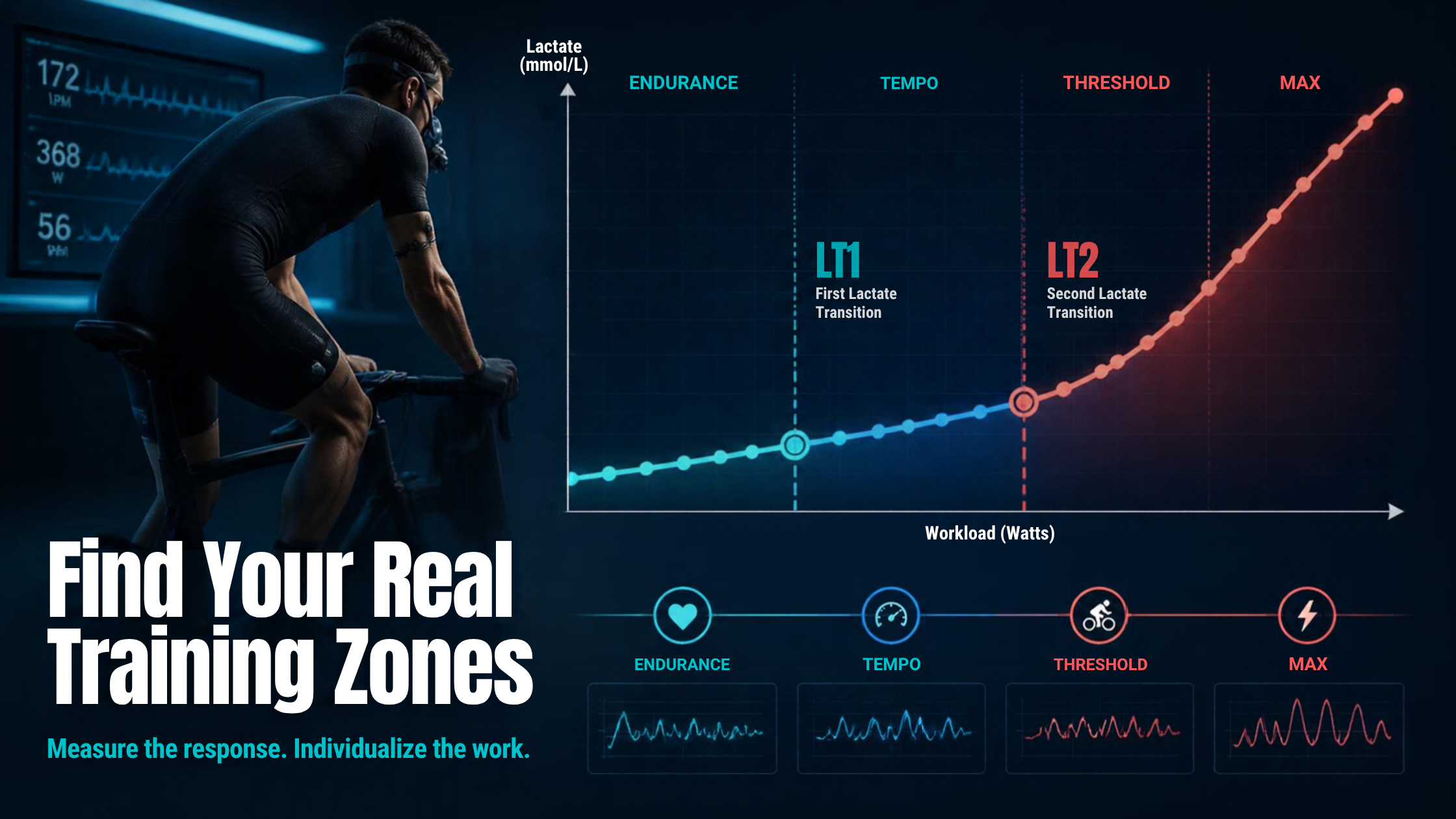
Understanding LT1 and LT2
Athletes will often hear the terms LT1 and LT2 when discussing lactate testing.
In simplified terms, LT1 describes a lower intensity transition where blood lactate begins to rise meaningfully above baseline. This region can help identify the transition from relatively easy exercise toward a more metabolically demanding intensity.
LT2 describes a higher intensity transition associated with a more pronounced rise in blood lactate. This region is often relevant to sustained endurance performance and the upper boundary of exercise that can be maintained without progressively increasing metabolic disturbance.
The exact terminology is more complicated than social media training charts sometimes suggest. There are numerous lactate threshold concepts, and researchers have used different mathematical and physiological methods to identify them. Fixed lactate concentrations, individual lactate thresholds, maximal lactate steady state, ventilatory thresholds, and other approaches are related but not identical.
This is why a lactate test should be interpreted as physiological data rather than simply searching for a universal number such as 2 or 4 mmol/L.
Why Generic Heart Rate Zones Can Miss the Individual Athlete
Many athletes train using zones generated from formulas based on age, estimated maximum heart rate, or percentages of a previously recorded maximum heart rate.
These methods can provide a reasonable starting point, particularly when more detailed testing is unavailable.
But population formulas cannot fully describe individual physiology.
Two athletes can reach the same percentage of predicted maximum heart rate while experiencing different metabolic demands. Even alternative methods for estimating physiological thresholds can show meaningful individual variation when compared with measured ventilatory or blood lactate thresholds.
Lactate testing allows us to work in the opposite direction.
Instead of beginning with a formula and assuming where the athlete's physiological transitions occur, we measure the response to increasing workload and then examine the corresponding heart rate, pace, or power.
That can make training zones considerably more individualized.
Lactate Testing Is Particularly Useful for Endurance Athletes
VO₂ max receives considerable attention in performance testing because it measures maximal aerobic capacity.
But endurance performance is not determined by VO₂ max alone.
An athlete also needs to sustain a high percentage of that capacity efficiently.
Consider two runners with similar VO₂ max values. One may be able to sustain a faster pace before lactate begins rising substantially, while the other reaches that metabolic transition at a lower workload.
Their maximal aerobic capacities may look similar, but their performance physiology is not identical.
This is one reason threshold related measurements are useful in endurance sports. Blood lactate thresholds and related physiological markers have demonstrated relationships with endurance performance, and lactate based intensity domains are commonly incorporated into training analysis and prescription.
For runners, cyclists, rowers, triathletes, and other endurance athletes, understanding these transitions can help provide context for training intensity.
Easy Training Should Actually Be Easy
One of the most useful applications of physiological testing can be identifying the intensity of lower intensity training.
Athletes often assume that harder training produces better results. In practice, successful endurance programs generally include substantial amounts of lower intensity work combined with smaller amounts of threshold and high intensity training.
Research examining trained and elite endurance athletes has repeatedly found that a large proportion of their training occurs below the first physiological threshold. Reviews of endurance training intensity distribution describe both pyramidal and polarized approaches, with substantial training volume performed at lower intensities.
This is where individualized thresholds become practical.
If an athlete's easy training consistently drifts into a more metabolically demanding intensity, the session may no longer provide the intended stimulus. Conversely, an athlete may be training unnecessarily slowly because a generic zone underestimated their actual capacity.
Testing gives the athlete additional information for making that distinction.
Hard Training Should Have a Purpose Too
The same principle applies at higher intensities.
Threshold sessions, tempo work, high intensity intervals, and competition specific training are not interchangeable. Each creates different physiological demands.
Knowing where an athlete's lactate response changes can help provide more context for selecting pace, power, and heart rate targets appropriate to the intended session.
This does not mean every workout should be dictated by a lactate number.
Training remains a combination of physiology, programming, recovery, sport demands, and athlete experience.
Lactate testing simply provides another objective layer of information that can make those decisions more individualized.
Lactate Threshold and VO₂ Max Answer Different Questions
VO₂ max and lactate testing are often discussed together because they provide complementary information.
VO₂ max asks:
What is your maximal aerobic capacity?
Lactate testing asks a different set of questions:
How does your metabolic response change as workload increases?
At what pace or power do important transitions occur?
What heart rates correspond with those workloads?
An athlete can therefore have a high VO₂ max but still have opportunities to improve how much of that aerobic capacity can be sustained during competition.
Conversely, an athlete with a more modest VO₂ max may perform extremely well because of favorable threshold characteristics, economy, efficiency, technical ability, and other performance factors.
Neither test tells the entire story.
Together, they provide a much more useful view of endurance physiology.
Why Athletes Should Re Test
One of the most valuable applications of lactate testing is not simply identifying current training zones.
It is measuring adaptation.
After an appropriate training period, an athlete may be able to produce more power or run at a faster pace at the same blood lactate concentration. The lactate curve may shift in a way that reflects changes in endurance capacity. Training has been shown to alter lactate and ventilatory threshold measures, although responses depend on baseline fitness and training characteristics.
This gives coaches and athletes another way to evaluate whether a training program is producing the intended physiological response.
A faster race is obviously meaningful.
So is understanding why performance may be improving.
Testing Conditions Matter
Lactate is useful precisely because it reflects physiology, but that also means the result can be influenced by testing conditions.
Training status, recent exercise, nutrition, carbohydrate availability, hydration, sampling technique, stage duration, workload progression, and other biological and methodological factors can influence blood lactate concentration.
Recent reviews emphasize the importance of controlling these factors when comparing measurements over time.
This is especially important for repeat testing.
If an athlete wants to determine whether physiology has changed, testing conditions should be reasonably standardized so that differences between tests are more likely to represent actual adaptation rather than differences in protocol or preparation.
This Is Not Just Testing for Professional Athletes
Lactate testing is commonly associated with elite endurance sports, but the information can be useful for serious recreational athletes as well.
You do not need to be preparing for the Olympics to benefit from understanding your physiology.
A runner preparing for a marathon may want better individualized training zones. A cyclist may want to understand how power corresponds with metabolic intensity. A triathlete may be trying to improve the ability to sustain race specific workloads. A competitive recreational athlete may simply want to replace generic training estimates with measured data.
The common denominator is not professional status.
It is having a performance goal specific enough that greater precision is useful.
Why Longevity Gyms Offers Lactate Testing
At Longevity Gyms, performance testing is intended to produce information that can actually be used.
Lactate testing allows us to examine an athlete's metabolic response as exercise intensity increases and relate that response to practical variables such as heart rate, pace, speed, or power.
For athletes already training with a smartwatch, heart rate monitor, cycling computer, running power meter, or structured training platform, this can make the data they already collect considerably more useful.
Instead of relying exclusively on generic zones, the athlete can begin with physiological measurements specific to their own performance.
For athletes who also complete VO₂ max testing, the combination can provide a broader assessment of aerobic capacity and metabolic response across increasing workloads.
The objective is not more data for the sake of data.
It is better information for training.
Measure. Train. Re Measure.
Athletic performance is ultimately demonstrated in competition, but performance testing can help explain what is happening underneath it.
Establishing lactate thresholds provides a baseline. Training can then be structured around the athlete's goals and physiology. Repeat testing can help determine whether those physiological markers have changed.
For an athlete who invests significant time in training, recovery, equipment, nutrition, and competition, understanding where training intensity actually sits can be valuable.
Your watch can tell you your heart rate.
Your power meter can tell you your watts.
Your GPS can tell you your pace.
Lactate testing helps provide physiological context for what those numbers mean for you.
Test Your Training Zones
If you are training for endurance performance and want a more individualized understanding of your training intensity, lactate testing can help establish your current physiological thresholds and the heart rate, pace, speed, or power associated with them.
Explore performance testing, recovery, and optimization at Longevity Gyms.
Medical Disclaimer
This article is provided for educational and informational purposes only and is not intended to provide medical advice, diagnosis, or treatment. The concepts of adaptive capacity, physiological resilience, and physical reserve discussed here describe broad areas of physiology and aging research and should not be interpreted as a diagnostic test or medical diagnosis. Hormone therapy, peptide based medications, prescription therapies, and other medical interventions require individualized evaluation and appropriate medical oversight. Consult an appropriately qualified healthcare professional regarding personal medical concerns, symptoms, diagnoses, medications, or treatment decisions. Longevity Gyms testing and services are not substitutes for individualized medical care.
Selected References
Lang JJ, Prince SA, Merucci K, et al. Cardiorespiratory Fitness Is a Strong and Consistent Predictor of Morbidity and Mortality Among Adults: An Overview of Meta Analyses Representing Over 20.9 Million Observations From 199 Unique Cohort Studies. British Journal of Sports Medicine. 2024;58:556 to 566.
García Hermoso A, Cavero Redondo I, Ramírez Vélez R, et al. Muscular Strength as a Predictor of All Cause Mortality in an Apparently Healthy Population: A Systematic Review and Meta Analysis of Data From Approximately 2 Million Men and Women. Archives of Physical Medicine and Rehabilitation. 2018;99(10):2100 to 2113.
Núñez Cortés R, Del Pozo Cruz B, Gallardo Gómez D, et al. Handgrip Strength Measurement Protocols for All Cause and Cause Specific Mortality Outcomes in More Than 3 Million Participants: A Systematic Review and Meta Regression Analysis. Clinical Nutrition. 2022;41(11):2473 to 2489.
Coelho Júnior HJ, Calvani R, Azzolino D, et al. Low Muscle Mass in Older Adults and Mortality: A Systematic Review and Meta Analysis. Experimental Gerontology. 2021.
López Otín C, Blasco MA, Partridge L, Serrano M, Kroemer G. The Hallmarks of Aging. Cell. 2013;153(6):1194 to 1217.
Garatachea N, Pareja Galeano H, Sanchis Gomar F, et al. Exercise Attenuates the Major Hallmarks of Aging. Rejuvenation Research. 2015;18(1):57 to 89.
Boccardi V, et al. Resilience Based Longevity Medicine: A Multiscale and Dynamic Integrative Framework. Ageing Research Reviews. 2026.
